
Google Business Profile review and optimisation
Categories, services, hours, photos, contact details, service areas and profile completeness.
Local SEO services London
TechneKaizen helps local businesses improve the way they appear across Google Search, Google Business Profile and location-relevant website pages, so customers can find accurate information and take the next step.
When Local SEO makes sense
Local SEO is a practical starting point for restaurants, shops, clinics, trades and other businesses whose customers search in a real area before they call, book, order or visit.
A visit, delivery area or on-site service is central to how the business earns work.
Useful searches include a town, postcode, neighbourhood or nearby intent.
Hours, contact details, categories, services or locations are unclear or inconsistent.
Other businesses are more prominent for the searches that matter to nearby customers.
Local business proof
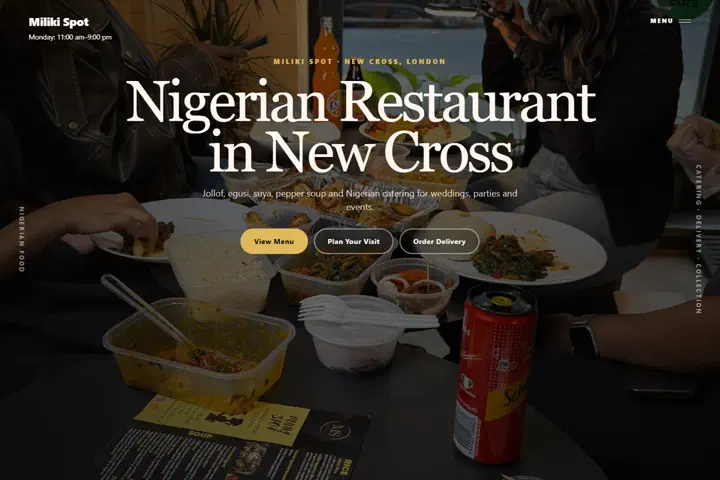
Miliki Spot is a Nigerian restaurant in New Cross, London. TechneKaizen designed and developed its mobile-friendly website, organising menu, location, ordering and catering information around the questions customers need answered.
Delivered work
Website design, development and Local SEO foundations, including clear location, menu, visit, ordering and catering routes.
What the example shows
A live restaurant property with specific New Cross information and useful paths from discovery to customer action. It is not a promise of a particular ranking, booking volume or revenue outcome.
What Local SEO includes
The exact scope depends on the business model and current gaps. A Local SEO project can include the following work where it is relevant.
Categories, services, hours, photos, contact details, service areas and profile completeness.
The services, places and questions that reflect how nearby customers actually search.
Alignment of the profile, website and important third-party listings.
Useful content for genuine locations and areas, not repeated town-name pages.
Indexation, metadata, headings, mobile usability and clear paths to contact or visit.
Clear relationships between services, locations, evidence and contact routes.
A consistent way to request genuine feedback and respond constructively.
Correction of important inconsistencies and duplicate profiles where justified.
Search Console, profile data and repeatable search checks tied to useful actions.
Website + Google Business Profile
Google Business Profile can introduce the business in Search and Maps. The website should then confirm the offer, location and next step. We review both rather than treating either as a standalone listing.
On the Business Profile
On the website
Location pages should exist because the business genuinely serves that location and has useful local information—not simply to repeat a city keyword across dozens of near-identical pages.
Business model and eligibility
A restaurant with a public address, a trades business visiting customers and an online-only company need different location strategies. We start with how the business genuinely operates.
| Business model | What it means for Local SEO |
|---|---|
| Storefront | Customers visit a staffed physical location. |
| Service-area | The business travels to customers or delivers in a real coverage area. |
| Hybrid | Customers are served at a physical location and away from it. |
| Multi-location | Each genuine operation needs distinct, accurate information and its own customer value. |
| Online-only | A business with no in-person customer contact may not qualify for a Google Business Profile. |
If the main challenge is being found for location-based searches, Local SEO is the right starting point. If the issue affects non-geographic topics, site architecture, crawlability or content across the entire website, broader SEO services may be more appropriate.
How we approach Local SEO
Confirm the real location, service area, customer journey and commercial priorities.
Review London and area-level search intent, competitors and the queries behind useful actions.
Correct conflicting details and connect the profile to the most relevant website experience.
Strengthen service, place and on-page information where the business can add genuine value.
Improve review routines, important listings, local evidence and clear contact information.
Use Search Console, profile performance, repeatable search checks and website actions to guide the next priorities.
Reporting can combine local query visibility, website impressions and clicks, profile interactions, calls, forms, bookings or direction requests where reliable data and tracking are available. Rankings vary by location, device and time, so they are read alongside customer actions—not in isolation.
Reviews and reputation
Reviews help customers understand what it is like to deal with a business and can strengthen its overall local-search presence. We help businesses create a consistent process for requesting genuine feedback, responding appropriately and keeping profile information accurate.
We do not fabricate reviews, gate negative feedback or use fake accounts.
Why TechneKaizen
Local discovery is not separated from the customer experience. We consider what a person sees in Search and Maps, whether the website confirms the same information, and whether the next action is clear on a phone.
Local SEO work is overseen by Joshua Nimako, founder of TechneKaizen. Learn more about the founder and consultancy.
Local SEO FAQs
Straight answers about eligibility, timing, Maps, reviews, location pages and measurement.
Local SEO improves how a business is understood and discovered for location-based searches. It connects Google Business Profile, website content, business information, reviews and genuine local relevance.
Initial reviews and fixes can begin quickly, but visibility develops over time. Timing depends on the starting point, competition, location, website and how quickly changes can be completed.
No. Searcher location, relevance, prominence, competitors and Google’s systems all affect results. No provider controls or can guarantee a particular Maps or local-pack position.
For many eligible local businesses, it is an important part of visibility in Google Search and Maps. The profile must represent the real business and follow Google’s eligibility rules.
A service-area business may be eligible if it genuinely visits or delivers to customers. If customers are not served at the home address, the address should normally be hidden from the public profile.
Yes. Trades, mobile services and delivery businesses can benefit when their real coverage, services and contact routes are clear. False addresses and virtual offices should not be used to create extra locations.
No. Create a location page only where the business genuinely serves the area and can provide useful, distinct information. Near-identical town pages can create a poor experience and search risk.
Reviews can support customer trust and local prominence, but quality and authenticity matter. Requests should be part of a genuine customer process, with consistent responses to positive and negative feedback.
Local SEO concentrates on location-driven searches, Maps, Business Profile, local pages and reputation. Broader SEO covers sitewide technical, structural and non-geographic search opportunities. Some projects need both.
We use relevant query visibility, Search Console data, profile performance and tracked website actions where available. Organic results and Maps observations are reported separately because they are different result types.
Start your project
Tell us where the business is based, the areas it genuinely serves and what customers should do next. We will use that context to identify the right profile, website and measurement priorities.