TechneKaizen

For existing business websites

Website redesign for small businesses with underperforming websites

If your website looks outdated, is hard to update, performs poorly on mobile or no longer reflects the business, the next step should be a structured review — not a blind replacement.

We assess what is creating friction, what should be retained and what needs to change before recommending targeted improvements, a structural redesign or a controlled rebuild.

No meaningful website to preserve? Explore Website Design.

Recognise the friction

Signs the current website may need redesigning

One symptom does not prove that the whole website needs replacing. It does show where a proper review should begin.

  • Your services have changed, but the website still describes the old business.
  • Visitors struggle to understand the offer or find the next useful action.
  • Mobile pages, menus, forms or contact routes are difficult to use.
  • The design or missing proof makes the business harder to trust.
  • Routine updates are difficult, risky or dependent on one provider.
  • Technical errors, instability or unclear recurring costs keep appearing.
  • Search visibility has declined, or pages duplicate and compete with each other.
  • Analytics or enquiry tracking is missing, incomplete or unreliable.
Observed symptomWhat a visitor, owner or report shows is going wrong.
Confirmed root causeWhat evidence shows should actually be repaired or changed.

Three possible routes

Redesign, repair or rebuild?

The right scope depends on what the current website is still doing well, what is creating friction and what risks would be introduced by changing it.

LOWER CHANGE

Targeted improvements

A possible fit when the platform and theme remain viable, the page structure is broadly usable and a limited set of issues can be corrected without creating unnecessary migration risk.

  • Clarify key pages or calls to action
  • Resolve isolated mobile or form friction
  • Retain the current platform, URLs and most content

MATERIAL CHANGE

Structural redesign

A possible fit when useful content and site value remain, but navigation, hierarchy, journeys or presentation need material reworking and the platform can be retained safely.

  • Reshape navigation and page hierarchy
  • Improve mobile journeys, trust and enquiry paths
  • Preserve or map valuable URLs and content

CONTROLLED REPLACEMENT

Full rebuild or migration

A possible fit when the platform, theme or codebase is a liability, the structure cannot support the business, or maintainability, security or compatibility problems justify replacement.

  • Inventory valuable pages, data and integrations
  • Plan relevant redirects and technical migration
  • Validate and monitor the replacement carefully

Starting without a meaningful existing website? Explore Website Design.

Is catalogue, cart, checkout or payment the main requirement? Explore Ecommerce Websites.

Review before recommendation

The website review and diagnostic stage

A useful recommendation connects visible problems to business, user, search and technical evidence. The review establishes that context before scope is agreed.

Explore deeper SEO support
  1. Business and audience

    Goals, priority services, customers and the journeys the website should support.

  2. Content and structure

    Page hierarchy, navigation, content quality, internal links and duplicated or competing pages.

  3. Usability and conversion

    Mobile use, forms, calls to action, trust, error states and enquiry paths.

  4. Search evidence

    Indexability, rankings, organic landing pages, Search Console and backlinks where evidence and access are available.

  5. Technology and access

    Hosting, theme and plugin condition, performance signals, ownership, admin access and integrations.

  6. Measurement

    Analytics and conversion tracking where available, including whether the current data is complete enough to guide decisions.

Evidence depends on access

Analytics and Search Console can be reviewed only when the client grants access. Without them, a review can still begin from visible structure, crawlable pages, content, mobile usability and platform signals, but search-equity decisions must be more conservative.

Protect useful value

What should be preserved

Retain value intentionally rather than replacing or preserving everything automatically.

Established URLs

Pages may have search, referral or customer value even when their presentation needs work.

Useful content and customer language

Accurate explanations, questions and terminology can be retained, consolidated or rewritten intentionally.

Backlinks and service relevance

Linked or relevant pages need evidence-led mapping rather than automatic deletion.

Brand assets and imagery

Recognisable, permissioned assets can remain when they still fit the business and the revised system.

Data and learning

Analytics history, conversion evidence and customer behaviour can inform better decisions where reliable data is available.

Integrations and familiar patterns

Useful operational connections and recognisable navigation can be retained when they remain safe and effective.

Preserving a redesign foundation is different from planning ongoing visibility growth. Explore SEO or Local SEO.

Scope follows evidence

What may need to change

A redesign can affect content, journeys, presentation and implementation, but this is a review framework — not a promise that every item is included in every engagement.

LIKELY REVIEW AREA

Clarity and customer journeys

These areas are normally reviewed because they shape whether people can understand and use the website.

  • Navigation and page hierarchy
  • Service structure and content
  • Mobile layouts and CTA hierarchy
  • Forms, internal links and accessibility

PROJECT-DEPENDENT CHANGE

Implementation and measurement

These changes depend on the evidence, current platform and agreed project boundaries.

  • Visual system and reusable components
  • Theme or plugin architecture
  • Performance and tracking foundations
  • Consolidation of duplicated or thin pages

SEPARATE SPECIALIST SCOPE

Work beyond redesign foundations

Some requirements change the delivery model or need ongoing specialist work and should be agreed separately.

  • Ongoing SEO or content programmes
  • Ecommerce operations and migration
  • Custom applications or complex integrations
  • Ongoing hosting or maintenance arrangements

Migration discipline

SEO preservation during redesign

The goal is to reduce avoidable migration risk, not to claim that rankings can never fluctuate.

  1. Understand the current site

    Inventory current URLs and identify valuable pages using business value, visible signals and analytics, Search Console or backlink evidence where access exists.

  2. Map the future site

    Preserve, consolidate or intentionally retire content; plan relevant destinations for URLs that will change rather than redirecting everything to the homepage.

  3. Validate technical signals

    Review internal links, metadata, canonicals and indexability so they point to the intended final URL set.

  4. Launch and monitor

    Update the sitemap, confirm final pages and redirects, then monitor crawl, indexation and search behaviour so issues can be investigated.

Important: Rankings can fluctuate after significant website changes, especially when URLs, content, internal links or technical signals change. Monitoring is risk management, not a guarantee.

Explore SEOExplore Local SEO

Make the next step easier

Conversion and customer-journey improvements

A redesign can improve the clarity and usability of enquiry paths. It cannot guarantee enquiries on its own: the offer, traffic, evidence, response process and wider market still matter.

Request a Website Review
  1. Intent

    Align the landing page with the need expressed in search, advertising or a referral.

  2. Understanding

    Make services, suitability and differences easier to grasp without searching through unrelated pages.

  3. Confidence

    Place permissioned proof, useful reassurance and ownership information near the decisions they support.

  4. Action

    Create a clear CTA hierarchy, usable mobile contact actions and forms that ask for appropriate information.

  5. Feedback

    Use understandable validation, error and confirmation states so users know what happened and what to do next.

Know what you control

Ownership, costs and maintainability

A redesign review can clarify admin access, provider-controlled hosting, licences, plugin dependencies, documentation and whether the website can be moved. The aim is transparency, not an assumption that every existing arrangement is unsuitable.

Useful questions to resolve
  • Who controls the domain, hosting and WordPress administrator account?
  • Which costs renew, why are they needed and who pays them?
  • What documentation, backups and transfer access exist?

WordPress software

WordPress.org software is open source. That is separate from the services and infrastructure used to run, secure and maintain a website.

Hosting

Hosting is the server service that keeps the website available. Provider, renewal cost, account ownership and moving process should be clear.

Premium licences

Themes, plugins, fonts or third-party services may have their own subscriptions, terms and transfer limits. Each dependency should have an identified purpose and owner.

Maintenance and support

Updates, backups, monitoring and support are services, not automatic features of WordPress. Responsibilities and response expectations should be agreed.

Agency or freelancer services

Strategy, design, development, content and specialist support are professional services. Scope, deliverables and ongoing charges should be documented separately.

Miliki Spot redesign

A redesign built around the way customers actually find the restaurant.

Miliki Spot is a Nigerian restaurant in New Cross, London. The redesign focused on making its menu, location, ordering and catering journeys clearer while strengthening the website's local-search foundations.

Miliki Spot restaurant website homepage after its redesign
Miliki Spot website — a Nigerian restaurant in New Cross, London.

Website usage

Google Analytics reporting

Previous calendar-year GA4 view
1.1K active users
Current year-to-date GA4 view
2.8K active users

Google Analytics shows materially higher website usage in the current reporting period. The data does not isolate the redesign as the sole cause of that change.

Local discovery

Customers are also finding Miliki Spot through relevant local searches.

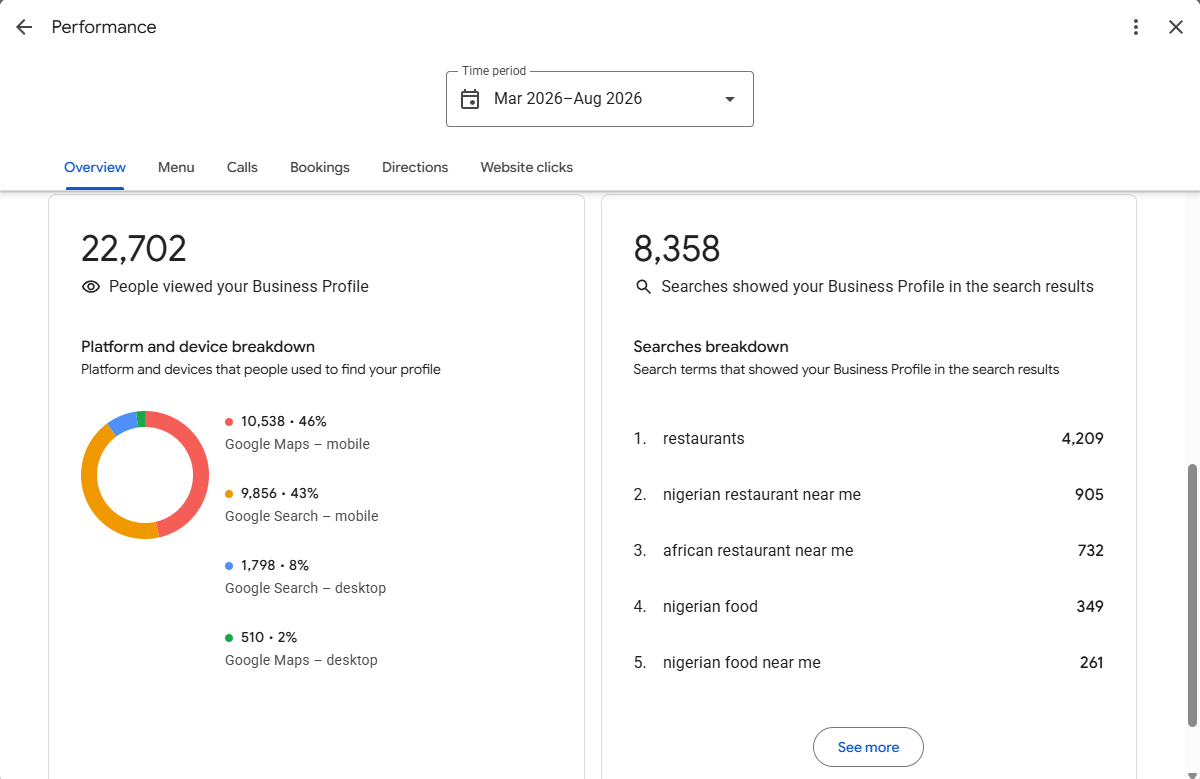
Business Profile views
22,702
Searches showing the Business Profile
8,358

Google Business Profile recorded 22,702 profile views and 8,358 searches showing the business between March and August 2026. Relevant searches included:

“nigerian restaurant near me”
905
“african restaurant near me”
732
“nigerian food”
349
“nigerian food near me”
261

Reporting-period qualification: The March–August 2026 reporting period spans both before and after the approximately May 2026 website redesign. These figures evidence genuine local-search visibility; they do not show that the redesign alone created every search or profile view, and no exact ranking position is claimed.

Google Business Profile Performance for March to August 2026 showing 22,702 profile views, 8,358 searches, relevant search terms, and Google Search and Maps discovery
Owner-supplied Google Business Profile Performance view, March–August 2026. Browser chrome was cropped; the reporting data was not altered.

The observed analytics and Business Profile data are kept separate from causal claims about the redesign, rankings, revenue, bookings, calls or direction requests.

A controlled route

Our redesign process

The exact delivery plan depends on the evidence and agreed scope. The process keeps preservation, migration and launch decisions visible instead of treating them as an afterthought.

  1. Audit the current website

    Review the business context, visible experience, content, search signals, technology and access available for the agreed scope.

  2. Identify what to retain, remove and improve

    Classify useful assets and pages, gaps, duplication, technical liabilities and decisions needing more evidence.

  3. Agree the future structure

    Set the page hierarchy, navigation, content responsibilities and customer journeys before detailed production.

  4. Design and build the revised experience

    Create and implement the agreed responsive system around clarity, accessibility, maintainability and the approved scope.

  5. Map migration requirements

    Record URL, content, redirect, integration, tracking, access and launch dependencies before changeover.

  6. Validate and launch

    Check the agreed pages, links, forms, responsive layouts, accessibility and technical signals before controlled release.

  7. Monitor and resolve launch issues

    Review crawl, indexation, redirects, forms and agreed measurement so launch defects can be investigated and corrected.

Request a Website Review

Practical risk questions

Website redesign FAQs

Qualified answers about rankings, URLs, WordPress, hosting, ownership and choosing the right service route.

Will I lose my Google rankings?

Rankings can fluctuate after significant changes. The aim is to reduce avoidable risk through URL inventory, content mapping, relevant redirect planning, technical checks and post-launch monitoring — not to promise that movement is impossible.

Can you redesign my current WordPress website?

Yes, when the current WordPress setup is a viable foundation. The review checks theme, plugin, content, access and maintainability constraints before deciding whether to retain, restructure or replace it.

Do I need to keep my current hosting?

Not necessarily. Hosting, domain and DNS arrangements can be assessed separately, but any move depends on confirmed account access, technical compatibility, backup and migration planning.

Can my current content be reused?

Useful, accurate content can be retained, rewritten, consolidated or mapped into the future structure. Reuse should be intentional rather than assuming every page should stay unchanged.

What happens to old URLs?

Current URLs are inventoried and mapped. Where a URL changes or is retired, any redirect should go to a relevant destination; valuable pages should not be sent to the homepage by default.

Can only part of the website be improved?

Yes, targeted improvements may be appropriate when the platform and wider structure remain viable. The review helps identify whether a limited change would solve the problem without creating new inconsistencies.

Will I own the redesigned website?

Ownership, administrator access and handover are clarified in the agreement. Completed custom work and client content are distinct from third-party software, licences and services, which retain their own terms.

How long does a redesign take?

Timing depends on the number and condition of pages, content decisions, approvals, technical dependencies, integrations and migration risk. A delivery plan should follow the review rather than a universal timeline.

How is this different from Website Design?

Website Redesign starts with an existing site and must assess what to preserve or migrate. If there is no meaningful existing website to preserve, Website Design is the better starting point.

What if another provider controls the website?

The review can identify missing admin, hosting, domain, DNS or licence access. What can be transferred depends on account ownership, contracts and cooperation from the current provider, so access should be resolved before launch planning.

What if we do not have analytics or Search Console access?

The review can begin from visible structure, crawlable pages, content, mobile usability and platform signals. Without historical search or behaviour data, decisions about traffic and search equity must be more conservative.

Can a redesign include ecommerce?

It can connect with ecommerce work, but if products, catalogue, cart, checkout, payments, stock or fulfilment are the dominant requirement, start with the separate Ecommerce Websites service.

Begin with diagnosis

Start with the website you have now

You do not need to decide whether the project is a repair, redesign or rebuild before enquiring. Start with the current website and the problems you are seeing. The appropriate scope can be determined from there.

Request a Website Review